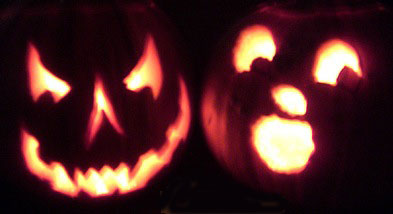
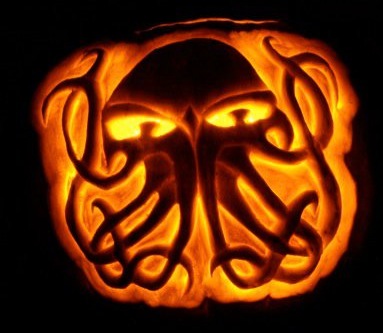
 Haven’t carved your jack o’ lantern yet? Now I prefer free-handing it myself, but if you want to get fancy or have had jack o’ disasters before, here’s a selection of places to find FREE stencils and patterns. If you want to do a Cthulhu o’ lantern like the one pictured, find the pattern here.
History.com
Readers Digest
DLTK
Better Homes and Gardens
Stoneykins
Prime Books: 31 Days of Halloween – Day 24Paula Guran | Oct 25, 2011 in NewsPrime Books: 31 Days of Halloween – Day 23Paula Guran | Oct 24, 2011 in News
Q: How do monsters tell their future? Q: Why do vampires need mouthwash? Q: Where do vampires keep their money? Q: What is a witch’s favorite subject in school? Q: How do you know a zombie is tired? Q: What instrument does a skeleton play? Q; What do you get when you cross a vampire and a snowman? Q: What happens when a ghost gets lost in the fog? Q: Why do demons and ghouls hang out together? Ba-dump-dump! Prime Books: 31 Days of Halloween – Day 22Paula Guran | Oct 23, 2011 in News
But it’s fairly easy for me to recommend five films for Halloween. I’m not a big horror movie buff. Shock and gore isn’t scary and for suspenseful “surprise” endings — I tend to guess endings in the first ten minutes. So, to be a favorite, a movie has to be memorable, one that I’m willing to watch more than once and still enjoy. In fact, some of my picks are more macabre—or even darkly humorous—than scary. And, yes, I cheat (there are really six films). I could cheat more and mention Sleepy Hollow, Edward Scissorhands, Beetlejuice, The Nightmare Before Christmas, Corpse Bride, and Sweeney Todd—but then we’d be having a Tim Burton-a-thon. You have to admit, though, the man is Halloween. 1. The Crow (1994) 2. The Haunting (1963) 3. The Witches (1990) 4. (Tie) The Others (2001) and The Sixth Sense (1999) 5. Dark City (1998) Prime Books: 31 Days of Halloween – Day 21Paula Guran | Oct 21, 2011 in NewsBlood “Everybody is a book of blood; wherever we’re opened, we’re red.” — Clive Barker
Vampires drink it. A werewolf’s bite poisons your blood and you become a beast yourself. Countess Elizabeth Báthory de Ecsed supposedly bathed in the blood of slaughtered virgins to retain her youth. Human monsters spill rivers of blood… Blood both attracts and repels. Needed for life, directly connected to death, the sight — even the thought — of blood elicits an immediate and deep-seated emotional response. Blood literally holds the power of life and death; humans have always assigned it magical capabilities, sacred meaning, and ritual significance. Blood can be taboo; blood can sanctify. Ancient Egyptians thought blood carried the essence of life. Roman gladiators drank the blood of defeated foes to gain their strength. The Bible mentions blood over 400 times. “For the life of the flesh is in the blood,” says Leviticus, then prohibits the children of Israel from consuming blood or allowing strangers who do so to live with them. Red wine was associated with the blood of the Greek god Dionysus, and his followers symbolically drank it as the god’s blood. The blood of Christ is signified by the wine of the Eucharist. Conversely, religious sacrifice marked by the spilling of the victim’s blood, “fed” and nourished ancient deities. From the Greeks through the middle ages, “scientific” theory held that the body was a microcosm of nature. Since natural phenomena was thought to be produced by combinations of the four elements — air, fire, water, and earth — it was assumed there were four analogous elements, or “humors,” governing the body. The four humors were phlegm, choler, bile, and blood. Blood was the Paramount Humor. It supposedly carried the vital life-spirit throughout the body, sloshing about through “pores” in the heart, ebbing and flowing back and forth through the veins and arteries. To maintain good health, one “balanced” these humors. Bleeding — intentional bloodletting — a person help achieve this. Phlebotomy — the “medical” practice of bloodletting — originated in ancient times and was practiced through the second Industrial Revolution. Indian and Arabic medicine included the practice of bloodletting, too. For more than twenty-five hundred years, patients were bled for every ailment imaginable (and some that were frankly imaginary) — yet there was never a shred of evidence that it did any good. Even as blood’s “magical” powers were transformed by modern science into a component of human anatomy that could be therapeutically transfused, perverse mythology still outweighed reason. Blood prejudice has been used to exclude and include. “Royal” blood was once held in special regard. The Nazis refused transfusions from non-Aryans and thus condemned their armies to constant shortages. During World War II, the American military shamefully separated blood stocks from black and white donors. Just before World War II, viable methods to collect and store blood and to separate plasma were discovered. (Blood separates into three parts: oxygen-carrying red cells, white cells and platelets, and a mixture of water, salts, and proteins called “plasma.”) A technique to “fractionate” plasma into its constituent parts and the ability to freeze-dry plasma gave the Allies an major advantage over the Axis powers. And it set the stage for a global industry. The blood industry brought life to millions in the last few decades. But distribution of blood and plasma products to millions also introduced the pathogens they carried. In the 1970s, blood-related hepatitis rates soared. As this problem seemed solved, another virus — HIV — brought its taint. Blood-borne hepatitis C became another health crisis. Modern science taught us that blood’s true magic lies in its ability to help heal. We’ve outgrown the notion that vampires could feed on our blood or that a werewolf’s bite would turn us into a lycanthrope. We no longer drink blood to acquire strength or bathe in it to restore youth. But the horror of HIV and other blood-borne viruses brings us back to the idea of blood as the bearer of death and “bad humors” back into our cultural consciousness. A new reading: an old fear from our books of blood. Prime Books: 31 Days of Halloween – Day 20Paula Guran | Oct 21, 2011 in News
With Spooky Sounds from Folk Alley you can listen to their Scream Stream online for a limited time only at www.folkalley.com/music/halloween. As they put it: Before there was Bob Dylan or Pete Seeger, or even Woody Guthrie, there were folk songs that were dark and gritty and filled with murder and mayhem. Perfect for Halloween! These wicked and tragic tales form the base of Folk Alley’s Scream Stream – five hours of spooky songs filled with ghosts, witches, graves, blood, goblins and more scary stuff. Warning: Folk Alley is not responsible for anyone foolish enough to listen to the Scream Stream alone or in the dark! It’s just too frightening! I highly recommend a listen!
|